
How to Detect If an Image Has Been Manipulated
A photo lands in your inbox, your feed, or a customer dispute. Something feels off, but you cannot point to a specific pixel. The good news: manipulated images leave forensic traces that software can measure, even when the edit is invisible to the naked eye. Four techniques cover the vast majority of cases, and all four can run in a browser without installing anything.
Published on: July 22, 2026
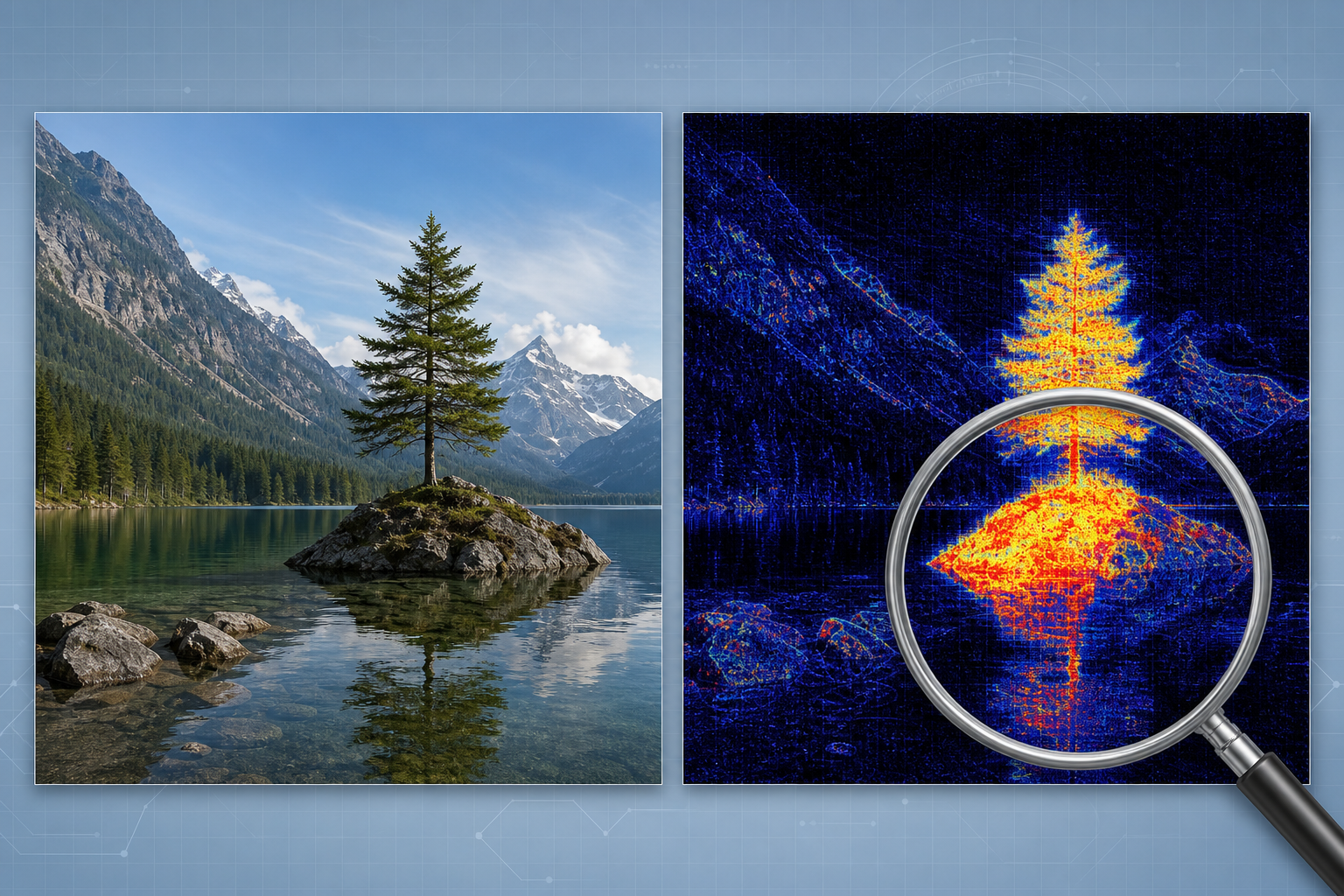
Error Level Analysis: Reading the Compression History
Every time a JPEG is saved, the encoder cuts the image into 8x8 pixel blocks, transforms each block into frequency values, divides those values by a quality table, and rounds. That rounding is permanent. In an untouched photo, every region has been through this process the same number of times at the same settings, so the entire frame settles at a similar error level.
Paste something into that photo and save again, and the pasted region carries a different compression history. An ELA tool re-compresses the image at a known quality and maps the difference between the original and the re-saved version. Regions that glow brighter than their surroundings have been through fewer rounds of compression, or different settings, than the rest of the frame.
A few things to keep in mind. Texture and contrast shift error levels on their own. A bright sky next to a detailed tree line will always show different ELA values, even in an untouched photo. ELA on a PNG or a fresh maximum-quality export will look bright everywhere, because there is almost no compression history to compare against. Treat ELA as a reason to investigate further, not as proof.
For a detailed walkthrough of the mechanics behind JPEG quantization, 8x8 blocking, and why edited regions end up with mismatched compression signatures, see how JPEG compression betrays edited photos.
Clone Detection: Finding Copy-Pasted Regions
A common manipulation technique is copying one part of an image and pasting it over another to hide or duplicate an object. Clone detection algorithms divide the image into overlapping blocks, compute a fingerprint for each block, and then sort those fingerprints to find near-identical matches in different parts of the frame.
When two distant regions share the same block fingerprint, the tool flags them. This catches duplicated textures, repeated patterns used to cover up removed objects, and stamp-cloned areas.
The limitation: large uniform areas (clear skies, white walls, solid backgrounds) will produce matching blocks by nature. Clone detection works best on images with varied texture and detail, where a genuine duplicate stands out from the surrounding content.
Noise Consistency Analysis: Spotting Composites
Every camera sensor produces a characteristic noise pattern. The grain in a photo taken with a phone at ISO 800 looks different from the grain in a studio shot at ISO 100. When someone composites elements from two different source images, the noise profile changes at the boundary.
A noise consistency map divides the image into regions and measures the statistical distribution of noise in each one. Regions that were shot under different conditions, or generated synthetically, show up as patches with different noise characteristics.
A related technique, noise naturalness mapping, measures the kurtosis (the "peakedness") of the noise distribution. Real camera noise tends to follow specific statistical patterns. AI-generated images often produce noise with lower kurtosis values, which a naturalness map renders in red, while regions matching natural photo statistics appear green.
Metadata Forensics: What the File Header Reveals
Before touching any pixels, check the file's EXIF metadata. A photo straight from a camera typically includes the camera make and model, lens information, shutter speed, aperture, ISO, GPS coordinates, and a timestamp. Software like Photoshop, GIMP, or Lightroom writes its own signature into the metadata when it saves a file.
A photo that claims to be an unedited original but carries an Adobe Photoshop software tag has been through an editor. A file with no EXIF data at all may have been stripped intentionally (which is common for privacy reasons, and tools like browser-based EXIF removers exist for exactly this purpose). Missing metadata is not evidence of tampering on its own, but combined with suspicious ELA or noise results, it adds weight.
GPS coordinates, when present, can confirm or contradict a photo's claimed location. Timestamps can reveal whether a photo was taken when it claims to have been taken. These are straightforward checks, but they catch a surprising number of fakes that went unexamined.
Putting the Four Techniques Together
No single technique is conclusive on its own. ELA can flag false positives from normal contrast differences. Clone detection trips on uniform textures. Noise analysis needs enough resolution to measure meaningfully. Metadata can be stripped or spoofed.
The power comes from combining them. An image where ELA highlights a suspicious region, clone detection finds duplicated blocks in the same area, the noise map shows a different grain pattern there, and the metadata carries an editing software signature, that image warrants serious scrutiny.
Browser-based tools that run all four analyses on a single upload make this practical for anyone, not just forensic specialists. The analysis runs locally in JavaScript and the HTML5 Canvas API, so your image never leaves your machine. Drag in a JPG, PNG, WebP, or BMP, wait a few seconds, and review each tab.
When to Go Deeper
Browser-based forensic tools cover the common cases well: detecting spliced regions, finding clone stamps, spotting composites from different sources, and reading metadata. For images where AI generation is the concern rather than manual editing, dedicated detection tools add machine-learning classifiers trained specifically on synthetic image artifacts, along with checks for invisible watermarks and provenance signals like C2PA Content Credentials.
The practical workflow: start with the four-layer analysis described above. If the results are inconclusive or if you suspect AI generation specifically, move to a specialized scanner that adds deep-learning classification on top of the traditional forensic layers. Most manipulation that matters in day-to-day work (retouched product photos, altered screenshots, composited scenes) will surface in the first pass.